
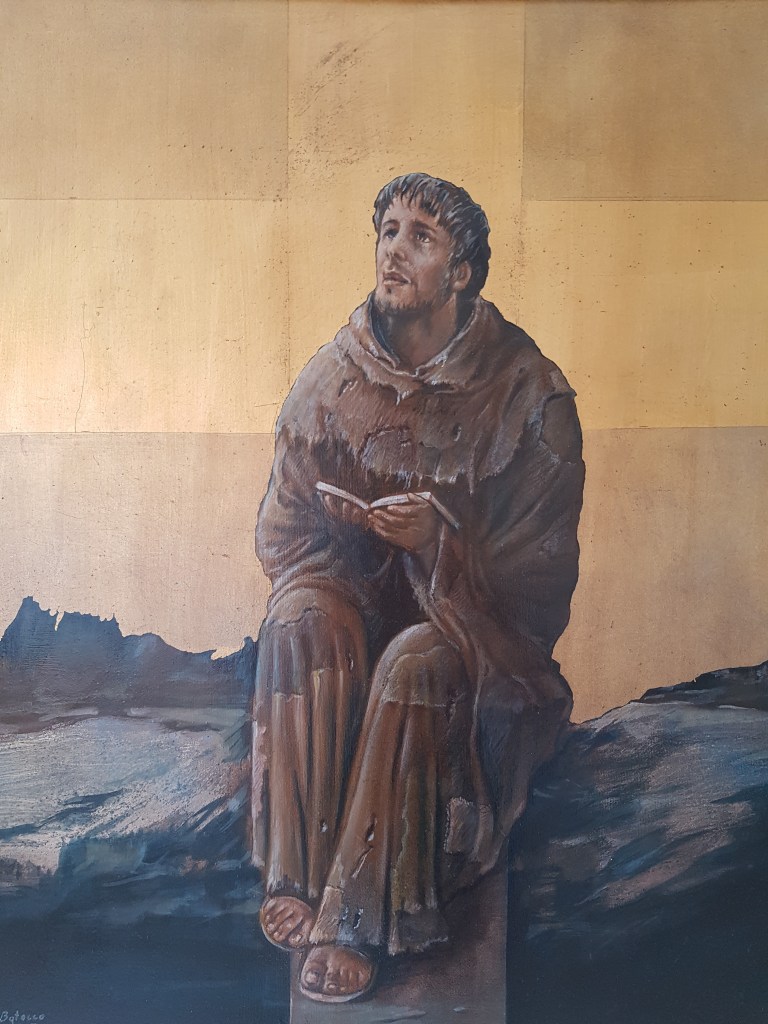
The third consideration of the stigmata reproduced in the Fioretti recounts for us how Francis, who is considering the mystery of God, is observed by Brother Leo. The report is then handed down by Leo that, in his meditation, Francis repeatedly proclaimed: ‘Who art thou, my dearest Lord? and who am I, …’ Francis asks himself the fundamental human question: ‘Who am I’ in the sight of God. The concrete form of life of Francis is born of this linkage between the decisive question of God and of his own humanity. His form of life, his spirituality and his theology are an answer to these two fundamental questions. His specific model for life and his spirituality are rooted in an articulating image of God. In this way, the figure of Francis of Assisi not only conveys a form of life, but also a characteristic way to interpret and think about God and humankind.
- His person, his form of life and the corresponding image of God were not confined to himself; instead, they became the basis for a diverse movement and of his own philosophical-theological approach. A process of ‘theologisation’ of his spiritual form of life began even during Francis’ own lifetime. The origin of Franciscan spirituality, philosophy and theology is thus not initially to be found in academic reflection, but in the experience of God and in the practical form of life of Francis. In the experience unique to Francis, the Most High, Almighty and Great God has humbled Himself completely in His Son, Jesus Christ, and, in humility and poverty, became the servant of humankind and of all creatures. Francis is deeply fascinated by the kenosis of God’s love and seeks with all his being to follow this love. The experience of the loving humility and of the humble love of God became decisive for the saint’s image of God and for the tradition that began with him and that continues in the academic reflection of philosophy, theology and in many other areas.
Francis, who described himself as an uneducated person, did not view the development of academic scholasticism and its approach to philosophy and theology without suspicion. However, the thesis frequently espoused – that Francis, who, following in the footsteps of Christ, was oriented towards life in poverty and humility, had rejected all manner of education and theological study – cannot be maintained as such. He did not despise the sciences but held that they must not be permitted to lead to pride or arrogance. He draws a clear distinction between the knowledge and awareness of the world, on the one hand, and Divine wisdom on the other. With this in mind, he invites all the faithful not to be clever in the flesh, but instead to be simple, humble and pure in order to serve all human creatures out of love for God. Francis wants to focus on true wisdom: ‘…the Son of God, Who is the true wisdom of the Father.’ For the saint from Assisi, the science and wisdom of the world have no meaning in themselves. His interest is directed entirely towards true wisdom revealed in Jesus Christ. All of his powers are aimed at discerning Divine wisdom and following this. He does not avail himself of the scientific method of the emerging universities for this purpose. Only through a hermeneutics of ‘innocence’ and simplicity can true wisdom be discerned in order to then follow it.
He himself opens up a space for theology within his community of brothers in the person of the teacher Anthony. He specified the direction and type of theological teaching in a brief letter sent to Anthony himself.
‘The Apostle says: The letter kills, but the spirit gives life (2 Cor 3:6). Those are killed by the letter who merely wish to know the words alone, so that they may be esteemed as wiser than others and be able to acquire great riches to give to [their] relatives and friends. In a similar way, those religious are killed by the letter who do not wish to follow the spirit of Sacred Scripture, but only wish to know [what] the words [are] and [how to] interpret them to others. And those are given life by the spirit of Sacred Scripture who do not refer to themselves any text which they know or seek to know, but, by word and example, return everything to the most high Lord God to Whom every good belongs.’
And in his letter to Anthony, he writes:
‘I Brother Francis send wishes of health to Brother Anthony, my bishop. It pleases me that you teach sacred theology to the brothers, as long as in the words of the Rule you “do not extinguish the Spirit of prayer and devotion” with study of this kind.’
Anthony instructed the brothers on Francis’ behalf, to prepare them for the task of the preacher. As a former Augustinian, Anthony’s teaching was based on an Augustinian-monastic theology that he likely revised under the influence of the new spirituality of the Friars Minor. His ‘Sermones’, a collection of materials and sermons intended to provide practical assistance in the preparation of the sermon, constitute the only surviving testimony of his doctrine. The ‘Sermones’ pay special attention to the Biblical message in order to shed light on the salvific activity of God in history and to call upon the listeners to convert and pursue a life of repentance and virtue. His patristic-monastic-Augustinian orientation combines with the Gospel-based vision of the life of the Friars Minor. He thus establishes a theological and spiritual orientation of importance to the continued Franciscan tradition. With his ‘Sermones’, Anthony lays out the guiding principles for a Franciscan style of preaching using his own didactic method. A reading of the Biblical text is of tremendous importance for this Franciscan didactics. The preacher must be open-minded in order to be essentially carried away by the text. Contemplation of the Biblical text studies ways in which faith can be realised in concrete, everyday life. The sermon itself then seeks to create a dynamic relationship between the preacher, the listener and the Holy Spirit. This places us at the dawn of the very momentous tradition of the Franciscan sermon, which, like the life of the brothers themselves, is oriented entirely around Holy Scripture.
Orientation around the Word of God
It is the orientation of the form of life, and of one’s own spirituality, that plays the most important role for the Franciscan tradition. Even the source documents on Francis’ life1 demonstrate how Francis’ calling arises out of concrete listening to the Word of God. Concrete Biblical texts play an important role in this regard. In a simple way, Francis feels directly addressed by the Word of God. This is how the Biblical texts he had heard opened up God’s revelation in a direct way in Francis’ life. Francis felt as if this revelation were speaking directly and personally to him. Francis developed his own unique way of listening to the Word of God, the Scripture. Francis heard the texts in an existential way. He did not interpret the Biblical texts in the way to which we are accustomed today. Instead, he interpreted the reality of his own life, the events great and small, in the light of the heard Word of God. He existentially placed his life into the heard Word. At the same time, Francis heard and read the Holy Scriptures with great freedom. He combined various Biblical texts with one another and enlisted the Scriptures to explain the Scriptures. Often times, his focus was on just a few Biblical texts. His christological approach to reading was fundamental in this regard; i.e., he understood and interpreted most texts as a reference to Jesus Christ. His interpretation of written texts was intuitive and often emotional as well. He always referred his interpretation back to concrete life. Only rarely is an interpretation purely spiritual in nature.
Not long after Francis’ death, in the movement of religious and lay faithful who invoked him, there began an in-depth theological interpretation of spirituality that was oriented around the Gospel and the form of life of Francis. What developed was an own hermeneutics of life, based on Scripture, that was typical of the Franciscan tradition. This hermeneutics is subject to the primacy of Holy Scripture and the Word of God. Holy Scripture is viewed as a living, formative word. The Word of God is always revealed anew in a personal and existential approach to reading and is proclaimed charismatically within Church tradition. This is how revelation develops a dynamics of its own within history. At the same time, there is direct contact between the person of faith and the Word of God in the Church, the community of listeners and the place of Scriptural interpretation. The common bond of Word and Sacrament is clearly seen. The Eucharist and the Word of God are equivalent forms of Christ’s presence in the Sacrament.
© 2020, JBF, MZF
 Franciscan Note