
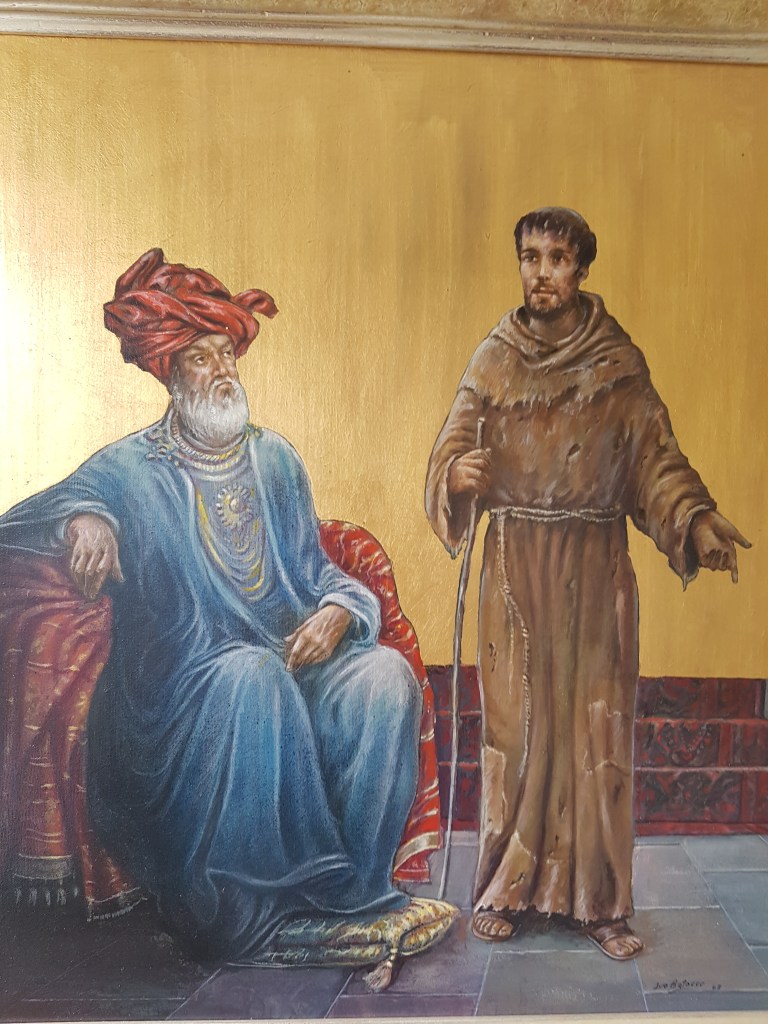
Characteristic of the theological work of many of the thinkers of the Franciscan School is to interpret Francis himself as a theological figure. His figure then manifests the Franciscans’ own typology of philosophical, theological and spiritual reflection. Francis becomes a ‘theological topos’ and hence a key to an approach to theological, spiritual and philosophical interpretation and hermeneutics. We can thus speak of a Franciscan approach to interpretation and hermeneutics.
This Franciscan view of interpretation and hermeneutics comprises a great variety of approaches, but these can be summarized along two broad lines: an interpretive approach to the life and person of Francis in a Christological prospective, and a second form of interpretation with a spiritual-eschatological orientation. The Christological interpretation culminates in the presentation by Bonaventura. On the other hand, the zenith of the spiritual-eschatological form of interpretation can be found in the works of Peter John Olivi. In spite of the diversity, difference and the areas of opposition sometimes seen between the Franciscans of the Middle Ages, one can still locate various basic features that give rise to a unity of Franciscan perspective and Franciscan thought. This unity of thought in the diversity and difference of perspectives finds its inspiration precisely in the ‘theological topos: Francis’. His hermeneutics of simplicity and plainness are the beginning and foundation of his own approach to study and science.
The basic principles of this own thought progressively developed by the Franciscans based on the ‘theological topos: Francis’ can be summarised as follows:
- The dialectics, or the interaction, between wisdom and science;
- The dialectics, or the interaction, between love and the intellect;
- The dialectics, or the interaction, between theory and practice;
- The dialectics, or the interaction, between the reality of history and the goodness of salvation.
a) The dialectics, or the interaction, between wisdom and science;
Both science and wisdom are based on the will, the innate desire and necessity of the human being to know. Etymologically speaking, science is the province of those who know, and it is synonymous with a sophisticated, systematic, methodical and rational education. In the Middle Ages, science in the broader sense of the term describes any knowledge and discernment that is based on understanding and serves the acquisition of insight. A knowledge that rests on demonstrable principles. Based on Aristotle, the Middle Ages takes a traditional approach towards the explanation of science: knowledge of things based on external, efficient, final, internal, formal and material reasons. This is the point at which science and wisdom meet. Wisdom is in a special way discernment of the things on the basis of their highest and most noble cause in the origin.
In the dialectics of wisdom and science, we find an interaction between two different ways of examining, investigating and clarifying everything having to do with life in the broadest sense of the term. Both science and wisdom seek to discern things and achieve insight into everything. Science considers matters in and for themselves and in the manner of their mutual interdependencies. Its process of investigation applies a specific method and rational reflection that follows a logical path.
In wisdom as understood by the Franciscans, all of the human faculties are oriented towards God and centred in Him. Wisdom is a form of enlightenment and elucidation based on meditation, contemplation and spiritual reflection. In a certain sense, Christian wisdom contradicts a wisdom of the world and seeks to recognise everything in Christ. All the treasures of wisdom and knowledge are hidden in Him.
The dialectics between wisdom and science respects the autonomy of things; it is based on the current findings of science and, at the same time, reflects on everything with a view to God. The findings that science provides are oriented integrally and fully towards the origin and primal principle of all Being. Thus, discernment and knowledge are not just an accomplishment of the scientist, but also a gift of God’s Spirit.
b) The dialectics, or the interaction, between love and the intellect
This second dialectic consistently follows the first. The intellect serves as an active tool of science, whereas love leads to wisdom. This dialectic offers an interaction between two different approaches to cognition. The intellect helps us mentally discern things as they are. Love is an affective discernment of the mystery that resides in all things in view of their origin. This interaction between love and the intellect not only recognises things as objects of experiment and research; it also recognises the intrinsic value, the inherent dignity of all things. Finally, the dialectics between love and intellectual discernment helps not only to recognise things in God, but, moreover, to view God in His Triune Mystery. The dialectics between love and the intellect leads to the experience of God through the knowledge of things.
c) The dialectics, or the interaction, between theory and practice
The Middle Ages make a clear distinction between the classification of theoretical and speculative science, on the one hand, and the classification of practical or moral science on the other. Theoretical and speculative science dealt with discernment and explanation of things in and of themselves. Practical or moral science spoke of the existence of human beings and their actions. Naturally, the Franciscans also engaged in theoretical and speculative science. But most of them were not interested in purely theoretical knowledge. Their studies, their research and their science were all geared towards practice. Here we find a third dialectics: theoretical study with a view to concrete practice. Knowledge of things in and of themselves had to help the human being find God. In most of the Franciscan authors, we find an effort to know the reality of human life and its challenges. Theoretical knowledge then served to improve people’s living conditions through love. This is how one can speak of a genuine interaction between practice and theory.
d) The dialectics, or the interaction, between the reality of history and the goodness of salvation
This interaction between practice and theory leads us to a further dialectics between historical reality and the goodness of salvation. The Franciscan realm in particular promoted not only metaphysics but also a philosophy and a theology of history. They promoted a reinterpretation of Creation, of the reality of life, of events and of history in the light of faith. This reinterpretation considered and interpreted the reality of history with a view towards a universal economy of salvation. This reinterpretation of history also led people to take a stance vis-à-vis the world, society and the Church. Precisely this dialectics between the reality of history and salvation was the engine of a strong missionary spirit to announce and practice the future values of the Kingdom of God in the here and now. In this context, we can distinguish between the two modes of interpretation: the more Christological interpretation and the more spiritual-eschatological vision. The Christological interpretation views the human, incarnate Jesus Christ as the already-fulfilled fullness of salvation and the necessity for humankind to join in this salvation on the path of faith and virtue. The more spiritual-eschatological view awaits the imminent return of Christ, for which humankind must prepare through radical conversion under the guidance of the Spirit. This dialectics between the reality of history and salvation takes the form of two different interpretive approaches and leads to insight into salvific history, into ‘historia salutis’, and challenges us to place all Being and all creatures into this new reality of salvific history that leads all of Creation to perfection in God.
The process of theologising the figure of Francis and the ongoing confrontation with this theological model provoked a deepening and further development of the hermeneutics of the ‘simplicity’ and ‘plainness’ of the saint from Assisi in the Franciscan realm. It seems that this very hermeneutics provoked by the example of Francis united all the Franciscan thinkers of the Middle Ages, even if their research methods and their results often diverged between them. But all stood on the ground of the faithful ‘simplicity’ of Saint Francis, a ‘simplicity’ that has nothing to do with stupidity, and instead inspires research, reflection and the heart as well.
Based on this hermeneutics, the Franciscan tradition attains four paths that lead to the wisdom of God: the path of knowledge, the path of freedom, the path of dialogue and, finally, the path to the Highest Good (bonum).
© JBF, MZF, 2020
 Franciscan Note