
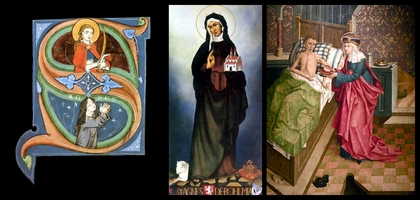
Clare writes to Agnes of Bohemia – A spiritual way
Whoever wants to know more about the spirituality of St Clare of Assisi has to read not only her Rule, but first of all her letters to Agnes of Prague. The daughter of the King of Bohemia, Agnes, searches for her own orientation and spirituality in her life and the foundation of her convent and turns therefore to Clare to ask her for encouragement, direction and help. Unfortunately, none of the letters of St. Agnes of Bohemia to St Clare of Assisi have been preserved but we have four letters of St Clare which very probably were in answer to some of the various enquiries of Agnes. These letters give a wealth of information on the spirituality of St. Clare herself. Because of the great lapse of time that passed between the four letters (the first letter was before Whitsun 1234, the second between 1234 and 1238; the third about the beginning of 1238, and the fourth probably in 1253), they might first of all give the impression of four spiritual occasional letters without necessarily an inner connection but a precise reading of the letters will allow us to perceive an inner connection and an even more intensive comparison of the texts will reveal that Clare not only gives Agnes spiritual advice but presents her with a true spiritual path which she herself had chosen and which she now encourages Agnes to take.
A critical analysis of her letters shows that in each of the letters St Clare describes a phase of her spiritual path. Each letter serves to trace the next phase of the spiritual path for Agnes and each is based on the same fundamental framework. Clare names the purpose, i.e., the relevant purpose of each phase of her spiritual path. She describes the difficulties and defines the necessary presuppositions in order to be prepared for the next phase which she describes in a lively manner as well as the fruit which will be obtained by those who decide to take this path.
With the help of this simple fundamental framework on which the four letters are based we will interpret the four letters one after the other: the purpose of the path, the presupposition, the description of the path and the fruit thus obtained.
1. Letter: from good to better
In her first letter to Agnes of Bohemia Clare begins to speak of the great end to be attained through the imagined spiritual path and then of the several phases which follow. Therefore, most beloved sister, or I should say, Lady worthy of great respect: because You are the spouse and the mother and the sister of my Lord Jesus Christ. (Verse 12.24). With these words which imitate the words in the letter of St. Francis to the faithful, Clare puts the purpose of her life before the eyes of Agnes: to become spouse, mother and sister of our Lord Jesus Christ, thus offering Agnes a true alternative to her „worldly destiny“. She is the daughter, i.e., the sister of the King of Bohemia, and the chosen bride of Emperor Frederic II., who asks for her hand in marriage. Her worldly and royal destiny is so to say transferred by Clare’s proposed purpose of life to a spiritual level and oriented towards Jesus Christ, the spouse of a more noble lineage (Verse 7). The destiny of Agnes to be bride, mother and sister is thus not rejected or even suppressed, but oriented to a higher purpose on the spiritual path. To be a bride, mother or sister regards also the feminine dimensions in the life of Agnes which are not negated because of the spiritual path but get a new value in this spiritual orientation.
At this point in the letter Clare proves her educational feelings. The idea of an honored and idealistic purpose of life can also be paralyzing and frightening. Therefore, at the very start Clare presents Agnes a first phase of the path which she has to follow in order to get closer to the great purpose step by step. Because of this I have resolved, as best I can, to beg Your excellency and Your holiness by my humble prayers in the mercy of Christ, to be strengthened in His holy service, and to progress from good to better, form virtue to virtue … (Verses 31-32). To advance from good to better in daily life is a realistic challenge that can be fulfilled. Clare expects just that and not more in this first phase of the path. She also clearly describes the dangers and the resulting presuppositions in order to be able to walk on the spiritual path from virtue to virtue. Worldly honors and dignities, pomp (Verse 5) and worldly riches (Verses 22.26-29) are the concrete dangers on the spiritual path of Agnes because of her noble origin. To disdain all this as Agnes had already begun to do is the irrevocable prerequisite to be able to follow the path.
Clare makes this first phase of the path even more concrete and points out poverty in imitation of Christ (Verse 15-20) and holy service (Verse 13). The holy service could be an allusion because together with the convent of Agnes there was founded a hospice for the poor in which the sisters cared for the sick. The progress from good to better is realized concretely in the imitation of the poor Christ and in the aforesaid holy ministry.
If Agnes takes this path she will soon reap the fruit of this first phase. Then rejoice and be glad. Be filled with a remarkable happiness and a spiritual joy! (Verse 21) Remarkable happiness and spiritual joy are given to those who walk on this path. Joyfulness and gaiety refer to the happiness of a fulfilled life and at the same time represent strength and an incentive to continue on this path.
2. Letter: To share the life of Christ
We cannot be sure when exactly this letter was written – it is probably in answer to a letter of Agnes and dates back to the years from 1234 to 1238. Reading the letter, we come to know that Agnes had been exposed to great external difficulties and hoped for Clare’s counsel. Clare answers in referring again to the spiritual path describing so to say the second phase of the path. Again, she gives a purpose to the phase. If You suffer with him, you shall reign with him; if you weep with him, you shall rejoice with him; if you die with him on the cross of tribulation you shall possess heavenly mansions in the splendour of the saints. (2EpAg 21) In the language of those times Clare points out to Agnes the sharing in the life of Christ. The first phase of the path from good to better is somewhat personalized in the life of communion with Christ. In order to be able to share the life of Jesus and to be in a life of communion with him the imitation must be very concrete. Look upon him who became contemptible for you, and follow Him, making yourself contemptible in the world for Him. (Verse 19). The ongoing spiritual path is now illustrated in concrete imitation. Again, Clare speaks about the obstacles and implicitly points to the hardships and present difficulties in the life of Agnes. The worldly and royal dignity and the proposal of marriage on the part of the emperor seem to have still been an obstacle. We know from historical sources that the royal family insisted for a long time that Agnes accept the emperor’s proposal of marriage because of political reasons. Furthermore, Agnes seems to have had difficulties to have her Rule and Way of Life approved by the Church. Again, in this connection Agnes, like Clare, was distressed. As a prerequisite to continue on the spiritual path Clare postulates feminine self-confidence, self-assertion and responsibility for Agnes in this situation. Believe nothing, agreeing with nothing which would dissuade you from this resolution or which would place a stumbling block for you on the way so that you may offer your vows to the Most High in the pursuit of that perfection to which the Spirit of the Lord has called you. (Verse 14). And: If anyone would tell you something else or suggest something which would hinder your perfection or seem contrary to your divine vocation, even though you must respect him, do not follow his counsel. (Verse 17) These are very clear words which do not shun necessary discussions in favour of the rightly acknowledged path.
Out of this phase fruit for the ongoing path will also grow perseverance and steadfastness. So that, like another Rachel, you always remember your resolution and be conscious of how you began. What you hold, may you always hold. What you do, may you always do and never abandon. But swift with pace, and unswerving feet, so that even your feet stir up no dust, go forward securely, joyfully, and swiftly, on the path of prudent happiness. (Verses 11-13)
3. Letter: bearing Christ in the womb
In the third letter, dated about the beginning of 1238 Clare deepens the spiritual orientation of life in the new phase of the path by inviting Agnes to bear Christ in her womb. Indeed, is it not clear that the soul of the faithful person, the most worthy of all creatures because of the grace of God, is greater than heaven itself? For the heavens with the rest of creation cannot contain their Creator. Only the faithful soul is His dwelling place and His throne, and this is possible only through the charity which the wicked do not have. He Who is the Truth has said: „Whoever loves me will be loved by my Father, and I too shall love him, and We shall come to him and make our dwelling place with him“. (14 Jn, 21.23). Therefore, as the glorious Virgin of virgins carried Christ materially in her body, you, too, by following in His footprints especially those of poverty and humility, can without any doubt, always carry Him spiritually in your chaste and virginal body. (Verse 21-25) With this description of the third phase of the purpose Clare refers to the theology of the Church Fathers according to the gospel of St. John, to the birth and living of God in the heart, in the soul, in the „motherly womb“ of the faithful. Clare thus puts her spiritual path in the tradition of the Church Fathers, especially the Oriental and Greek Fathers, who developed this theology as a spiritual way of life for all the faithful on the basis of meditation on the Holy Bible.
Because Clare sees arrogance and vanity as the biggest obstacle in this phase of the path for Agnes the latter is supposed to bring about the downfall of arrogance and vanity with the help of wisdom. I see that, helped by a special gift of wisdom from the mouth of God Himself and in an awe-inspiring and unexpected way, you have brought to ruin the subtleties of our crafty enemy and the pride that destroys human nature and the vanity that infatuates human hearts. (Verse 6) It is certain that Clare again refers to the spirituality of St. Francis who, in the Salutation to the Virtues, put wisdom in Verse1, at the top of all virtues. Of all virtues true wisdom is revealed in Jesus Christ, the incarnation of the Word of God.
It was true wisdom then which made it possible for Clare to describe this third phase of the path in a more transparent way. Agnes can reach the purpose of this phase by looking into the mirror of eternity. Here Clare uses an instrument, the mirror, which for sure in medieval times was very precious and played an important role in the life of a princess. Agnes probably already owned and used a mirror because of her education and background. Here again we see the educational competence of Clare. She does not ask Agnes to throw away the mirror in contempt and strict asceticism, but the mirror must get a new meaning for Agnes, i.e., on a spiritual level. Perhaps a vain habit of the princess up to then is now changed and becomes an opportunity to change into a profoundly spiritual lifestyle. Place your mind before the mirror of eternity! Place your soul in the brilliance of glory! Place your heart in the figure of the divine substance! And transform your whole being into the image of the Godhead Itself through contemplation. (Verse 12-13) The Mirror which anyhow was very important in medieval feminine spirituality was not supposed to reflect Agnes the way she was but she was to perceive herself as being an image of God in the mirror and compare herself always to this image and adapt ever more through meditation and formation. Meditation and formation will then have their concrete field of testing, as in the custom of Lent which Clare explicitly describes in order to dissuade Agnes from an indiscreet and impossible austerity (Verses 31-40).
Clare wishes that Agnes be filled with joyfulness and a lack of bitterness. Dearly beloved, may you too always rejoice in the Lord. And may neither bitterness nor a cloud of sadness overwhelm you … (Verses 10-11). This joy refers also to the health of body and soul (Verse 42). It becomes so much more visible that the spiritual path between Clare and Agnes and her sisters results in an ever greater spiritual solidarity and sisterly communion.
4th. Letter: a holy life of union
The fourth and last letter of Clare to Agnes probably dates from the year 1253. That means that many years passed between the third and the fourth letters. It is Clare who speaks in this letter about the fact that there had been little contact by letters and gives also an objective reason: the lack of messengers and the dangerous roads (Verse 6). This letter was written in the year in which St. Clare died. In this letter she sums up her whole spiritual life experience and passes on to Agnes the peak and purpose of her spiritual path. In order to reach this purpose a last phase of the path must be concluded, in order to get married to the Lamb. Since, like another most holy virgin, St Agnes, you have been marvelously espoused to the spotless Lamb Who takes away the sins of the world. (Verse 8) Clare notes that the last prerequisite is to leave all vanities of the world behind. the dangers of vanity permeate all her letters like a red thread. Repeatedly Clare asks Agnes to flee them. It seems that for a long time Agnes had to fight against this bad characteristic which is no surprise if we consider her origin and education. Again, the mirror – really an instrument of vanity – is put on the spiritual level and therefore revalued as an instrument of the spiritual life. During this last phase of the path the reflection on the mirror gets even more intensive. Agnes is not supposed to look at herself in the mirror because the mirror now reflects the life on earth of the Bridegroom Jesus Christ from the manger to the Cross. Look upon that mirror each day, O queen and spouse of Jesus Christ, and continually study your face within it…. Indeed, blessed poverty, holy humility and ineffable charity are reflected in that mirror, as, with the grace of God, you can contemplate them throughout the entire mirror. Look at the parameters of this mirror, that is, the poverty of Him Who was placed in a manger and wrapped in swaddling clothes. O marvellous humility, O astonishing poverty! … Then, at the surface of the mirror, dwell on the holy humility, the blessed poverty, the untold labours and burdens which He endures for the redemption of all mankind. Then, in the depths of this same mirror contemplate the ineffable charity which led him to suffer on the wood of the Cross and die thereon the most shameful kind of death… (Verse 15-23) This reflection on the mirror is enhanced in the imagination of Clare and Jesus Christ on the cross becomes the mirror in which the saving love of God is reflected. Therefore, that mirror suspended on the wood of the Cross … (Verse 24). Now this love is supposed to inflame Agnes more and more in her life. From this moment, then, o queen of our heavenly King let yourself be inflamed more strongly with the fervour of charity. (Verse 27) The purpose of the spiritual path has been fulfilled now with this last fruit in the holy life of communion with the bridegroom. Clare describes this life of communion with quotations from the Song of the Songs. (Verses 28-32) At the same time the vocation of Agnes and Clare is fulfilled in their being spouse, mother and sister. The great purpose of the spiritual path which Clare puts before the eyes of Agnes already in her first letter is now passing from one phase to the next and reaches Clare herself who already sees her death approaching and recommends herself and her sisters to Agnes and says her good – bye. Farewell, my dearest daughter, to you and to your daughters until we meet at the throne of the glory of the great God and desire this for us. (Verse 39)
Reading Clare’s letters to Agnes on the basis of the fundamental framework – purpose of the phases, phases of the path, dangers and prerequisites as well as each ripened fruit – helped us to open up the spiritual path described by Clare in her four letters and show the spiritual depth herein. Thus, both Clare and Francis developed an independent and feminine version for a spiritual path of life. This spiritual path of St. Clare is based on a profound knowledge of Holy Scripture and of the theology of the Church Fathers and becomes concrete in view of the real life situation of the daughter of the King, Agnes. In order to make this spiritual path fertile for the whole Franciscan family the single elements and phases of the path must be made concrete and updated.
Task:
* Read and meditate on the letters of St. Clare of Assisi to St Agnes of Bohemia.
* Elaborate a spiritual path inspired by the path of St. Clare.
* Define the scope and purposes for the single phases.
* Name the concrete obstacles and dangers.
* Formulate the necessary prerequisites, in order to be able to follow this path.
* Describe the fruit you hope for.
© 2020, JBF, MZF
First publication: Online-Journal Propositum Vol. 7. Nr. 1 September 2003
 Franciscan Note